

Deciding how to divide time with your kids after a separation is one of the heaviest choices you will face, and it is normal to feel stuck before you even start. You do not have to design a schedule from nothing. Most Texas families settle into one of a handful of common child custody schedules, and each has a clear rhythm you can picture before you agree to anything. Some split time equally between both homes. Others give one parent the primary home and the other steady, regular time. Below, you will see how these arrangements actually work day to day, how Texas law shapes them, and how to match one to your child’s age and your family’s routine.
At a glance: To start you off, you’ll need to figure out whether you’re going to follow the Texas Family Code schedule, divide parenting time equally, or divide time unequally. Equal, or 50/50, options include the 2-2-3, week-on-week-off, and 2-2-5-5 schedules. In Texas, the legal starting point is the Standard Possession Order, not an automatic 50/50 split.
How Texas’s Standard Possession Order shapes your schedule

Under Texas law, possession means the actual physical custody schedule of when each parent has physical custody of the child. Most Texas parents share joint conservatorship, which is decision making for the child, and follow a possession schedule for the day-to-day time. If those terms feel like a foreign language right now, our breakdown of joint versus sole managing conservatorship walks through the difference in plain English.
The Texas Family Code does not address a 50/50 split for possession. Rather, the schedule that is written into the Texas Family Code is the Standard Possession Order, which spells out when each parent has the child. Under the standard version for parents living within 100 miles of each other, the parent without the primary home has the first, third, and fifth weekends of each month, Thursday evenings during the school year, alternating holidays, and about 30 days over the summer.
The Texas Family Code also addresses the Expanded Standard Possession Order, which is the presumption. It stretches Sunday night and the Thursday visit into overnights. Picture a typical month: the non-primary parent has the kids from Thursday after school through Monday morning on the first, third, and any fifth weekend, plus a Thursday overnight in the weeks between. Add about 30 days in the summer and alternating holidays, and the time adds up faster than the “every other weekend” label suggests.
In the custody cases our attorneys handle across Central Texas, most parenting plans begin with this possession order and then get adjusted to fit the family and parents’ responsibilities. Holidays and school breaks follow their own separate rules and can shift the yearly totals, which we cover in our guide on how divorced parents split the holidays.
50/50 Custody Schedules: 2-2-3, Week-On/Week-Off, and 2-2-5-5
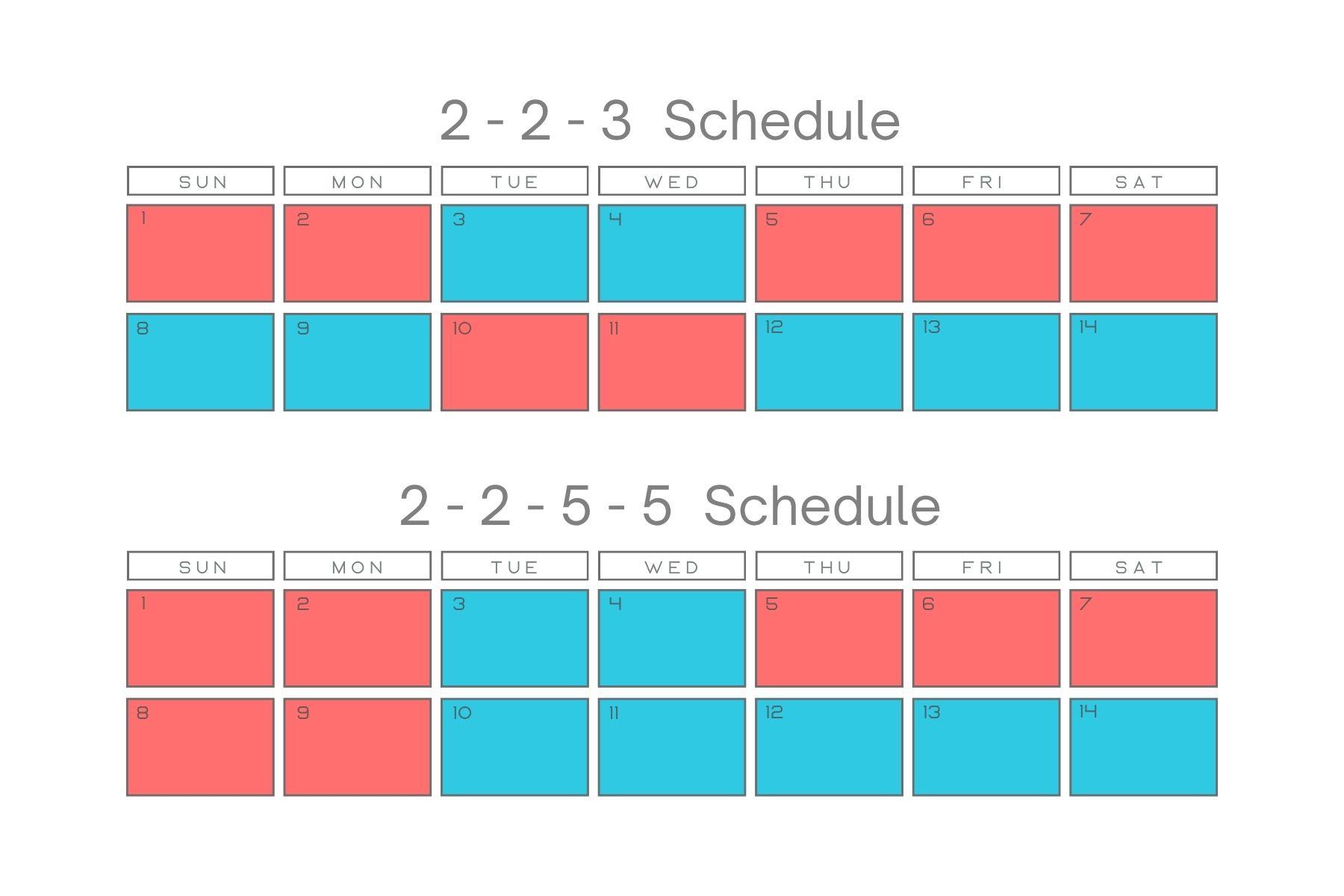
There are several versions of a 50/50 schedule, which can be tailored to fit your family’s needs:
- 2-2-3: The child will have two days with one parent, two days with the other parent, then three days back with the first, and the whole pattern flips the following week. No one goes more than three days without seeing the child. This rhythm suits younger children, who often do better with frequent contact and shorter time apart.
- Week-on, week-off: The child spends one full week with each parent. This is the simplest 50/50 option, and it suits older kids and teens who can handle a longer stretch away from one parent.
- 2-2-5-5: Each parent keeps the same weekdays, and the weekend alternates, giving each parent two days on, two days off, five days on, five days off. Each parent always keeps the same two weekdays, which makes school and activity planning predictable.
Which one fits usually comes down to how far apart you live and how easily your child settles into a second home. Fewer exchanges mean fewer flashpoints for conflict, as even the most cooperative co-parenting situation is bound to have issues, though they also stretch the gaps between seeing each parent.
Other Possession Schedules
A more custom parenting schedule might be the right fit for your family. Parents can create a different schedule when the standard possession schedule or a true 50/50 is not workable, but both co-parents still want real, substantial time, or if one parent is the main caregiver for the child. Contact an attorney to discuss potential alternatives to parenting time schedules.
Match the schedule to age, distance, and conflict

The best custody schedule is simply the one that serves your child. Factors include: your child’s age and specific needs, the distance between your homes, and how well you co-parent. A toddler usually needs frequent, shorter visits, which favors an expanded standard possession order or a 2-2-3 possession schedule if 50/50 possession is desired. A teenager often prefers fewer disruptions and longer stays, which points toward week-on, week-off. Allowing your child to form healthy relationships with each parent is important.
Conflict belongs in that equation too. Research on children in shared arrangements suggests they generally do better with substantial time in both homes, as long as they are kept clear of the fighting between their parents. A plan with fewer, calmer handoffs can shield your child from being caught in the middle.
The biggest mistake parents make is choosing a schedule to “win” more time rather than to serve the child. Texas judges decide contested cases on the best interest of the child, so a plan that works for your kids carries far more weight than one built around scorekeeping.
Getting the schedule right
The schedule that works is the one built around your child’s real life, not the one that looks fairest on paper. Start from an arrangement that gives your child stability, then adjust the details until it matches your actual weeks: the school pickups, the work shifts, the drive between homes. This works best when the parents can both co-parent without conflict. When you and the other parent can agree, Texas courts will usually honor a plan that clearly serves your kids. If you are still figuring out what a workable co-parenting time arrangement even looks like, our child custody attorneys can help you match the right arrangement to your child, your routine, and your goals.
Frequently Asked Questions
What is the most common custody schedule? The most common custody schedules are the Standard Possession Order, which is the default under Texas Law, followed by a 50/50 possession schedule.
Is 50/50 custody best for kids? It can be, but not always. Research suggests children often benefit from substantial time with both parents, but a 50/50 schedule only works well when parents live close together, communicate without constant conflict, and the child adjusts comfortably to switching homes. What matters most is stability, and frequent exchanges can help or hurt a child’s well-being.
What is the best custody schedule by age? Younger children usually do best with frequent, shorter visits, such as an Standard Possession Order, expanded or otherwise, or a 2-2-3 schedule, so they are never away from a parent too long. School-age kids and teens often handle longer stretches better, which makes week-on, week-off a good fit.
What is the biggest mistake in a custody battle? The biggest mistake is fighting for a schedule to “win” against the other parent instead of building one that fits the child. Texas courts decide on the best interest of the child, so a plan centered on your kids’ real needs carries far more weight than one aimed at keeping score. Protecting your child’s life and well-being comes first and foremost.
Can we change our custody schedule later? Yes. Life shifts, and Texas lets parents request a modification of a court order when circumstances change, such as a move, a new work schedule, or a child’s evolving needs. You will generally need to show a meaningful change since the last order.


